
Passing the time with a six-month-old

One of the joys of being a second bloom parent is that when the Baby King looks closely at my face, he instinctively reaches for the loose folds of my skin.

At least he’s too young to comment. At his age there is only the bald unvarnished truth and for me, obviously, the truth is bald. But I’m going with my niece’s idea (when she was four) that I haven’t lost my hair at all, it has actually yet to grow. ‘There are already some fluffy bits at the back,’ she told me. My hair ebbs and flows like sea – and currently the tide is out.

A close inspection of my face is one of the ways in which my son and I pass the time. He pulls my lips out as far as they can stretch, prises open my eyelids and closes my nostrils until my ears pop. It’s great fun. Blowing raspberries is another excellent use of a few minutes. I pretend we’re practising the two different phonemes, “th”, but really we’re just making funny noises. You can keep your satire, wit and deconstructive comedy. If you want a really good laugh, blow a raspberry.

But these activities, brilliant though they are, are not sustainable for an entire day. It’s thirty years since I was last the father of a six-month-old baby and I had forgotten that at this age he will spend much of his time attached to either Sally or me. And he insists we are always be on the move to satisfy his vestigial instinct to keep one step ahead of the predators.
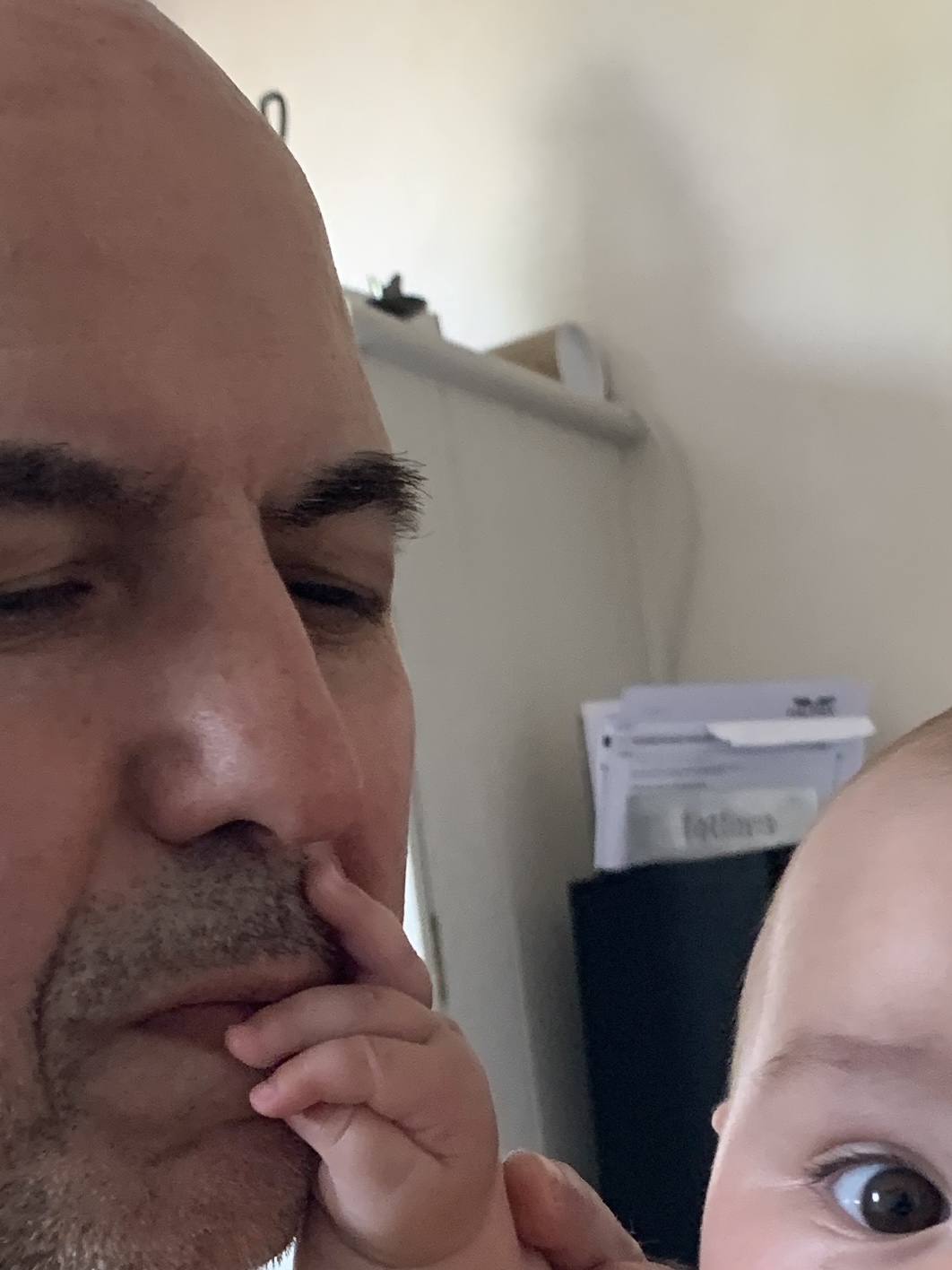
pre-lip stretching

Carrying a baby around the house is how I imagine walking on another planet would be. Ordinary movements become planned manoeuvres and ongoing terrain assessments. When I walk down the steps I look exactly like Neil Armstrong descending from the lunar landing module.

I still have my muscle-memory from the old days: picking up, putting down, carrying around. It’s the muscles that are missing. However, as his royal pleasure is to endlessly bounce up and down on my lap, I can use him as a free weight workout. If I do five sets of twenty lifts every day I could expect a respectable pair of deltoids by the time he is three.

We take him out as much as possible, travelling light with just a buggy and/or a sling, a fully-equipped nappy bag, extra bottles of milk, thermos covers, a blanket, a rain cover, toys, hats, muslin cloths, bibs and a change of clothes (just in case). We can often be ready to go in under an hour these days.

… Incidentally, on the subject of clothes, a message for sleep suit manufacturers – please ditch the poppers and buttons. At three in the morning, in the half-light, with a squirming baby on a changing mat, lining up a set of poppers is not helpful. Zips: ankle to neck, with built in scratch mitts. Thank you …

We take him to swimming lessons as well. He’s doing fine having been dunked weekly for the last three months. His incredulous look that I would do such a thing to him has passed. Now he assumes that if I am in the pool then sooner or later he’s going under. He’s clearly biding his time for when he’s big enough to return the favour.

As often as possible, we sit quietly with a picture book. It’s nice to be reacquainted with such authors as Shirley Hughes, Jill Murphy and Judith Kerr. I recommend The Great Dog Bottom Swap by Peter Bentley and Mei Matsuoka. It’s excellent. I read to him and we discuss the characters’ motivations and our expectations as readers, but all he really wants to do is to eat the book.

… while I am recommending books, I am consuming a lot of fiction myself, especially in the wee small hours. So these days I appreciate a shorter book and I recommend the novella, A Month In The Country by J L Carr. It’s a quiet story set a small village after the end of the First World War. The hero is one of the few people in the country who can uncover medieval murals in churches, and his immersion into local life, his thoughts on his work and his fragile situation are a gentle study of bucolic life, love, death and the dull ache of regret for missed opportunities, both big and small. A Month In The Country is a Penguin Modern Classic and costs about £8.99 …

At night, with the Baby King falling asleep on my lap exhausted after a day of poking his fingers into my eyeballs, bouncing up and down, raspberry-blowing, swimming, travelling and book-eating, it is my turn to look at his perfect face.

It is the most wonderful moment. I gaze at him and become lost in the thought that soon, surely, the tide will turn and my hair will grow back again.


Facebook school friends: let’s move on

Version 3I am in contact with only two of my schoolfriends. By contact, I mean we actually meet face to face – until COVID, that is. With everyone else, either the bonds weren’t strong enough or I was too lazy to keep things going. But having more past than future can make one twitchy, and I recently found myself reflecting on what happened to everyone and what life threw at my classmates.

Inevitably, Facebook knew. Just a few clicks found a group dedicated to my school’s alumni. And there they all were (well, most of them), my classmates: the good, the bad and the extremely naughty; all grown-up.

Joining the dots between then and now is a bitter-sweet experience. Judging by the tone of the posts, they haven’t aged at all – but the Facebook photographs suggest otherwise. We look like our parents and some of us look like our grandparents. Especially me. Gravity takes its toll and the weight of years has led to dodgy knees and bald heads – or is that just me again?

DEQIE7754

Not everyone in my year has joined the group and most of those who have, dip in and out. Interestingly, those with whom I have kept in touch don’t appear in the group either. I’m not sure what that says but I think it says something. Perhaps we died and no-one told us.

There are, however, a few who post comments all the time, feeding memories with an enthusiastic regularity. The irony is, I remember them being the keenest to leave school. Perhaps it is a way of being young again; the posts a verbal teenage avatar. I suspect a few might prefer who they once were to who they are now – or maybe they see a chance to rewrite history by replacing their old self with a modern version? Time, the great leveler. Be nice now and people might forget what an awful shit you once were.

Maybe that’s mean, but friends I remember being pushed to the fringes of playground society are now in cheerful discourse with those who pushed them there. That’s good and long may it continue, but I wonder if this social re-balancing would last were we all to be physically reunited for more than a day or two. It’s hard to imagine Piggy sharing rose-tinted memories with Roger and Jack on their post-apocalyptic Lord of the Flies Friends’ page. ‘Do you remember that lovely time you stole my glasses and then dropped a boulder on my head?’

Talking of Piggy, I was hoping to find some posts about me but disappointingly my name seldom crops up. I am so absent I had to check I actually went to that school. It seems I left little or no impression on anybody which is odd because I have a clear recollection of being extraordinarily popular. Too bad that’s a memory nobody else shares.

However, other, darker, memories are posted. Complaints of casual racism, chronic bullying and punitive abuse by teachers. But just as casually, any attempt to discuss these traumas are closed down with comments such as ‘that was then and this is now’ and ‘it’s best to move on.’ Best for whom, one wonders? And move on to what? Voices unheard all those years ago remain unheard; the idyll is not to be broken. I am reminded that it is dangerous to be different. That is true now and it certainly was then. Screen Shot 2020-05-17 at 12.24.37

And so the posts return to safer ground with questions such as ‘who was your favourite teacher’ and ‘what music did you dance to’. I liked to play air-guitar with my head in a bass speaker. I have no idea why but time passes and it’s best not to look for motives where there are none. It’s just what we did.

I have a platonic relationship with the past. I don’t want to forget it but I also don’t want to relive it. I would jump at the chance to be sixteen again (knees permitting), but only if I could take my current mind with me. I suppose like most people I am trying to walk up Time’s down escalator.

Being social media migrants means we must be careful about getting carried away in an online world. We might forget this jaunt down memory lane is in reality a public and open forum. Feelings can be hurt, confidences broken, libel laws breached. Worse still, we might encourage each other to wear cheesecloth and cream baggies again.

One day we will all know everything about everyone. There will be no secrets and the past will sit side-by-side with the present. Only the future will remain unknown and unknowable, as COVID-19 has demonstrated. But that’s how it should be. “That was then and this is now” is indisputably true, but it’s tomorrow that interests me. And (at the moment) not even Facebook knows for sure what that will be.

Don’t rush a good thing

Watch out, many of the baby boomers’ final cohort will be turning 60 this year – those born in the satisfyingly neat year of 1960 (it is so easy to work out how old one is, when there’s a zero at the end).

So expect a deluge of articles on the subject – how entering the seventh decade is a liberating experience, that 60 is the new 40, that age is just a number (well, yes, but it does mark some passage of time) and that the best is yet to come.

But let that big birthday come at its own pace. Exciting though it is to become a sexagenarian, don’t rush towards it. I am one of those baby boomers, and I find I am already thinking of myself as being 60 even though I’ve another six months to go. That’s the problem with an approaching landmark-birthday, it’s like watching a giant planet from a small moon: it fills one’s horizons.

The decade of my fifties has been good to me and I don’t want to be rude by dashing off without saying a proper goodbye. I want to enjoy a full twelve months between one set of candles and the next.

So, my sixtieth birthday can wait its turn. No sneaking a few months from my fifties. When it comes I will embrace it with gusto but I do not expect to see any changes in what I do or how I do it. My only question is this: while I am being so determinedly 59 who will actually plan my birthday celebrations?

Seriously, it’s only six months away.

The shape of something

I have an idea, elusive and shadowy, but definitely there. The shape of something. The right something. It needs to be pushed and prodded (gently), given substance by being handled. Coaxed into the light so I can see it more clearly. A story. A novel. A something…

I am not a plotter. At least, not yet. Let the characters talk. Get a flavour of their voices; the tone of their behaviour. For now leave the ‘plot’ up to them – the sequence of events and the order in which those events unfold.

The crafting and honing and structuring and arcing and three-act-versus-fiveing, and the sanding and polishing and waxing and editing and proofreading and welding and cutting and turning and trimming and changing and sewing and betareading and previewing and wrapping-up-and-tying-in-a-bowing and serving-up-on-a-dish-for-your-delectationing, all can wait.

The things I want to write down, to capture wholly, comprehensively, exhaustively and to my satisfaction, are caught up in that twisting tumbling shape. They are the shape. They are to do with being and not being; the little things and the big things; things I’ve seen and known and things I wish I had; moments and continuums.

Cartoons

Back in the late 80’s and early 90’s of the last century (oh that feels bad) I had a brief but rewarding period drawing cartoons for a magazine called the Freelance Informer. Sadly, that fine magazine for the IT contracting industry has long since published its final issue but it remains a treasured memory.

I drew six panel cartoons and five strip cartoons. They are dated – this was a time when desk top publishing (DTP) was a new thing, and ‘cutting and pasting’ still meant just that (I have kept my scalpel) – and, to be honest, they’re not that funny or even that good. This was never going to be a career because I can’t draw. But I was young and immortal and knew no better. And I liked them.

Looking at them now I’m struck by their innocent air and clean finish. I remember taking great pains to remove all the working lines. and simplify the outlines as much as possible. That minimalistic approach, the polishing to hide the hard work, rears its deceptive head in almost everything I do these days. Blame the 60’s and the cartoons of Hergé and Schulz and Mad magazine. I do.

Foolishly, I didn’t keep copies of the entire magazines, only the pages on which my work appeared – again, my youthful vanity – but I do know the volume and issue numbers, so if anybody is out there that knows the dates please do share them with me. Specifically, they are:

  • Volume 5 numbers 8, 11, 12, 14 and 15
  • Volume 6 numbers 18, 23 and 24
  • Volume 7 numbers 8 and 13

Weeding words (not in an Elmer Fudd sense)

This is my incomplete but sometimes useful list for when I am down in the weeds of editing. I’m sure you will have your own lists but these are the words, phrases and elements of punctuation that regularly get the secateurs treatment.

Words:

  • actually
  • almost
  • appeared to
  • by (unwanted passive writing alert)
  • could
  • definitely
  • hopefully
  • in fact
  • just
  • less (vs fewer)
  • little
  • perhaps
  • quite
  • rather
  • really
  • seemed to
  • so
  • while
  • with (see ‘by’)
  • would

Plus:

  • any adverb
  • American spelling or not (depending on where you’re standing)

Punctuation

  • too many commas (or too few) – I, over-comma
  • hyphens – I over–hyphen
  • semi-colons – I love semi-colons; too much;
  • double full stop at the end of  a sentence or paragraph..
  • double  space following a full stop
  • missing full stop at the end of a paragraph
  • “” vs ‘

Feel free to add your own items in the comments box below.

The Wrong Story Blog Book Tour

The Wrong Story, is going on a blog book tour. Here’s the poster with its itinerary. I’ve asked it to send postcards. Do you think I should have a tour T-shirt made up?

The Wrong Story Blog Tour Poster

By the way, if you want to help its sibling to get out there and join it, there’s still time to pledge for An Other’s Look at https://unbound.com/books/an-others-look/

A bone is born

I’ve broken my elbow. To be precise, I’ve fractured it. To be utterly accurate, the end of my funny bone has been chipped off. I’ll leave the gags to you. I was knocked over by a group of charging youths late on Friday night. It was an accident; these things happen; it could have been worse – I could have chipped a bit off my head. The lesson I’ve learned is to wear body-armour whenever I go to Bath.

I’ve never broken a bone before, at least I don’t think I have, but now I wonder about all those times I tripped and landed on my knees when I was young. Are there fragments of my fractured knee drifting inside my joints?

On the X-ray I could see the end of my funny bone floating some distance from the main bone, like an off-shore island. Its shape exactly matched the coastline where it had once been. I felt strangely uplifted, as if it were setting off on a new adventure.Elbow

While the X-ray was being displayed the nurse explained the purpose of each bone inside my arm. But she had to agree that, strictly speaking, I now have an extra bone in my arm, and one that has no purpose at all. I like that. I am proliferating.

It’s been a while since I was clattered to the ground. The last time was when I was thirteen and playing rugby. I was a terrible rugby player and they only picked me because I was big and heavy. The opposing scrum would charge at me and knock me flat and then run over me in their studs. Sometimes my own team did that too. Getting back to my feet in Bath city centre  brought back many of those happy childhood memories. And it’s made me wonder if adults fall over enough. I don’t think we do. I think we need to establish controlled environments where we can go on a Saturday morning and spend an hour or so tripping up and falling flat on our faces. Just like we did when we were young.

I feel positive about this new pain in my life. There are lots of advantages to having a broken elbow. Playing my ukulele, for example. I can only strum and pick for a few minutes at a time. This is a tremendous relief to so many people. And carrying things and lifting things up – I don’t have to. In fact, almost any household task can be avoided by saying, ‘I have broken my elbow’. Even typing takes its toll which means I have the perfect excuse to finish whatever I’m writing, such as this blog post, whenever I want, and without having to come up with a witty or satisfying or logical ending…

The Limehouse Golem review – a big helmet with lots of makeup – 3/5

The Limehouse Golem is a Ripperesque throat-slasher stuffed full of London fog, grubby horse-drawn coaches, grimy cockney characters and naïve prostitutes with dirt smeared on their faces. Was it ever clean in London?

It stars Bill Nighy, Olivia Cooke and Douglas Booth, ably supported by a bald Eddie Marsan who steals scenes and Daniel Mays who wears a big helmet.

Directed by Juan Carlos Medina , based on the book by Peter Ackroyd, Dan Leno and the Limehouse Golem and with a screenplay by Jane Goldman, the film is a convergence of two storylines: a series of explicitly gory and unsolved murders in olde London-town and the trial of a musical hall comedienne Lizzie Cree (Cooke) who is accused of murdering her failed playwright husband. Drawing these strands together is Inspector John Kildare (Nighy) and his sidekick, Constable George Flood (Mays).

Plot-wise, the requisite twists, turns and red herrings of any self-respecting whodunit are all in place, along with the bold device of the audience seeing each suspect in situ as the murderer, but what really keeps us guessing is how much was the makeup bill? Most of it is slapped on the musical hall mentor and star turn, Dan Leno (Booth), but there’s plenty left over for everybody else. My tip for any school-leaver is to forget university, get into the makeup supply business and win a contract for films based in Victorian London. You’ll be on velvet for the rest of your life.

For me, despite the calibre of the cast and crew, it’s the plot-driven narrative that is the film’s weakness (unless you like people being cut up with knives in which case it’s all great). Yes, it keeps us guessing but is that enough? I think it’s reasonable to expect more of the character-driven strands to be developed, such as Kildare’s past victimisation (just say he’s gay and be done with it) and his relationship with his sidekick Flood (just say he’s gay and be done with it), or the way in which the claustrophobic dynamics within the theatre’s ‘family’ worked. Otherwise, why mention them?

The characters are, with the notable exceptions of Lizzie Cree and Dan Leno, thinly drawn. I doubt Flood is meant to be a Watson to Kildare’s Holmes but even so, Daniel Mays must be wondering what is the point of his character other than to take the weight of his considerable headgear. Remove Constable Flood from the film and nothing changes. But it’s Inspector John Kildare who gets most of my sympathy. No DNA sampling, no crime scene forensics, no computers – and he’s being played by Bill Nighy.

Olivia Cooke and Douglas Booth are fascinating to watch on screen because they bring something of the human condition to their characters – but with Bill Nighy the acting is in what he doesn’t do – which is act. With Bill it’s all about the twitches, stares, stiff movements and The Face. The joy is watching Bill Nighy ‘be’. He is a character in his own right who simply has lots of different jobs: louche academic, resurgent pop singer, ageing lover and now a Victorian policeman, Inspector Bill Nighy.

As the credits rolled I was left with a feeling that the likes of TV’s Sherlock and Ripper Street have done this sort of thing to death, and done it well, and that this film needed to be something really special to justify its big screen status, something more than just a neat tale. Sadly, it’s not. I think more bald men and smaller helmets might be called for. And makeup. Lots more makeup.

10 Don’ts & 1 Do

Six months after turning to freelance writing full-time, I’ve learned some lessons. Mostly about what not to do. Here are ten Don’ts and one Do.

  1. Don’t blog about writing (hem) when you should be writing. You’re not fooling anyone – you’re playing for time.
  2. Don’t get two-thirds of the way through the first draft of your novel and then decide to restructure it by spending two months creating a detailed storyboard using balsa wood, different coloured pens, colourful sticky labels and map pins. You are now a storyboard manufacturer, not a writer.
  3. Don’t re-cut your rejected short story into a radio play just by adding columns and colons. It’s the same story, you idiot.
  4. Don’t self-promote your novel so much that people start to block you, delete you or apply for restraining orders. Begging random passers-by to read your book is usually counter-productive – and let’s face it, it’s demeaning.
  5. Don’t kid yourself that an experimental story in which all the characters, irrespective of gender or species, have the same name will ever be read by anyone on this entire planet. It won’t. It will be garbage.
  6. Don’t begin an editing course unless you want to temporarily inhibit any joy you ever had in writing creatively. You can be an editor and a writer but not both in the same moment. You will implode.
  7. Don’t study your Amazon sales rankings and compare them to those of other writers you know. It hurts.
  8. Don’t edit your 5000 word story so that you can enter it into a 500 word Flash Fiction competition. It just doesn’t work. Also, you have lost all your critical faculties and should take a holiday.
  9. Don’t track your progress on a spreadsheet unless you want to spend all day tracking how far behind schedule you’ve fallen.
  10. Don’t expect to earn any money at all. Keep telling yourself it’s all about the art.


  1. Do just write. Every day. As many words as you can. Preferably in the correct order.  Occasionally in pleasing combinations. That’s what writers should do. Mostly.


Version 2
Staring at a window all day doesn’t get the novel written, either.