I have an idea, elusive and shadowy, but definitely there. The shape of something. The right something. It needs to be pushed and prodded (gently), given substance by being handled. Coaxed into the light so I can see it more clearly. A story. A novel. A something…
I am not a plotter. At least, not yet. Let the characters talk. Get a flavour of their voices; the tone of their behaviour. For now leave the ‘plot’ up to them – the sequence of events and the order in which those events unfold.
The crafting and honing and structuring and arcing and three-act-versus-fiveing, and the sanding and polishing and waxing and editing and proofreading and welding and cutting and turning and trimming and changing and sewing and betareading and previewing and wrapping-up-and-tying-in-a-bowing and serving-up-on-a-dish-for-your-delectationing, all can wait.
The things I want to write down, to capture wholly, comprehensively, exhaustively and to my satisfaction, are caught up in that twisting tumbling shape. They are the shape. They are to do with being and not being; the little things and the big things; things I’ve seen and known and things I wish I had; moments and continuums.
As part of its pre-launch marketing process, Unbound have arranged for Happy Family to be serialised on The Pigeonhole. This is a great way to get reviews and build a buzz before its publication early next year. You can check it out and get early sight of the text here: https://thepigeonhole.com/books/happy-family. If you do, please a leave a review.
This is both exciting and daunting because even though it’s pre-publication, it’s now ‘out there’.
So, where are we in the overall publication process? Well, all of the editing and final proofreading is complete which is why The Pigeonhole can use the text. In the next two or three weeks I will see the roughs of the cover design – I can’t wait for that – and shortly before Christmas, pre-publication digital versions will be sent to formal reviewers to get cover quotes – perhaps some of The Pigeonhole reviews will be used too.
After that, around February, it’s the full launch of the actual book and distribution to bookshops. Hooray!
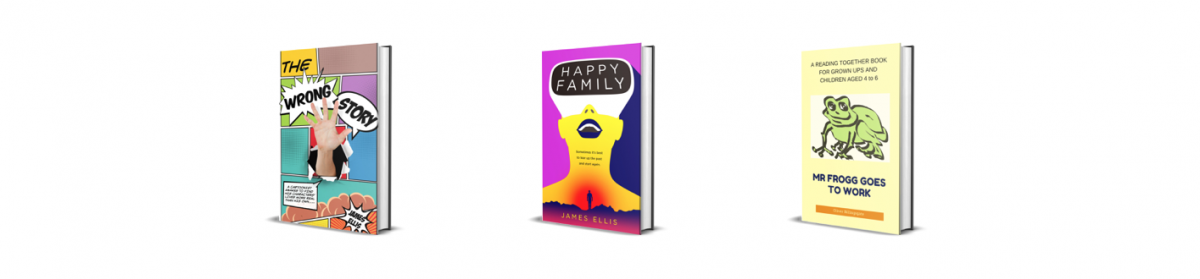
After much discussion the working title of my second novel, An Other’s Look, has been changed to Happy Family.
I love this title because it works at so many different levels. The book is scheduled for release in early 2020 and it has now been through two rounds of developmental editing, a full line (copy) edit, and a full proofread. And some very nice things have been said about the book along the way – here are a few examples:
‘The novel feels extremely fresh and contemporary … One of the clever things about the novel is that it shows how rather than bringing families together in the same way that board games such as Monopoly, Battleship, Cluedo etc used to, AR games can be used to drive families apart and further isolate the individual from society.’
‘As a comment on the way modern day game development could affect the whole idea of the happy family, and its invasive potential repercussions for vulnerable players, it is a sobering piece of work.’
‘Its imagined snapshot of the huge part AR may have to play in the future, and the hefty price tag consumer expectation versus reality may come with … is both fascinating and terrifying in equal measures. A particularly effective scene showing the disconnect between reality and the imagined world is both perfectly imagined and genuinely frightening.’
‘Could you please tell the author that I really enjoyed this book … I could even picture the characters… and who should play them in the film!’
As the old joke goes: ‘There are three rules to writing novels. Unfortunately nobody knows what they are.’ I like that. Recently, I was a guest speaker at a writers’ workshop and I was asked what rules I follow. I paraphrased Elmore Leonard and said never start with the weather. It wasn’t a satisfactory answer.
The same questioner then asked me if I could recommend a good book that taught fiction writing. I quoted the old saw: ‘You can’t teach someone to be a good writer but they can learn.’ Again I sensed my reply had gone down badly. Specifics were needed. Well then, my questioner demanded, what have you learned?
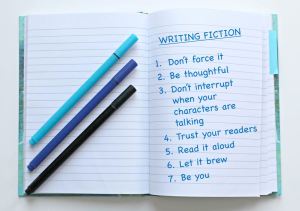
I looked around. What had I learned? “Don’t force it,” I said.
“Beg pardon?”
“Don’t force it – if it’s not working, move on. And be thoughtful. Write thoughtfully. And don’t butt in when your characters are talking. Keep out of it and let them get on with it. And trust your readers. They’ll get it, they really will. Read it out loud all the time and when you’ve written it, whatever it is, put it away and let it brew. And most importantly, be you. Don’t be any other writer. Write like you write.”
There was an awkward silence.
“Any other questions?” I said. Fortunately, there weren’t.
This is my incomplete but sometimes useful list for when I am down in the weeds of editing. I’m sure you will have your own lists but these are the words, phrases and elements of punctuation that regularly get the secateurs treatment.
Words:
actually
almost
appeared to
by (unwanted passive writing alert)
could
definitely
hopefully
in fact
just
less (vs fewer)
little
perhaps
quite
rather
really
seemed to
so
while
with (see ‘by’)
would
Plus:
any adverb
American spelling or not (depending on where you’re standing)
Punctuation
too many commas (or too few) – I, over-comma
hyphens – I over–hyphen
semi-colons – I love semi-colons; too much;
double full stop at the end of a sentence or paragraph..
double space following a full stop
missing full stop at the end of a paragraph
“” vs ‘
Feel free to add your own items in the comments box below.
I’d like to tell you why I’m so excited by An Other’s Look that I can override my natural awkwardness and ask people to help me; why I am willing to thump the drum and rattle the cup and toot the whistle for pledges.
An Other’s Look is my second novel and builds on all that I thought I had learned when writing The Wrong Story. In this book I wanted to write about journeys and change and transitions, and I wanted to exorcise a few personal demons. I wanted the writing (and the reading) to be fun and I also had some unfinished business with three of the characters from The Wrong Story – Germaine, Tom and Gerard.
But two months into its writing I realised I hadn’t learned as much as I thought, and I had to go back to basics – and I mean basics: what the hell is a story anyway? I knew where I wanted to go, I just didn’t know how I’d get there. As part of this reboot I thought I’d just let my characters talk and butt out while they did so. I’d let them chat to each other while I tried to figure out what to do.
But what happened was that their dialogue and interactions took over and drove the story forwards faster than I could type it. I’d found a working method that just flew. What emerged six months later was a story with plot lines that all converge on a lonely and isolated Spanish peninsula town called Las Sombras, in north-west Spain.
Hence the thumping and rattling and tooting. I can’t wait for you to meet these characters – the damaged academic, Germaine Kiecke; the bereaved artist Tom Hannah and his new young muse, Alta; the Machiavellian Gerard Borkmann; the ageing voice-over artist Charles Cubberley, his Belgian wife Margot and his fellow actor and nemesis, Roger Pendleton; the sinister hotelier Rodolfo whose wife and father-in-law have both gone missing; his avenging sister-in-law, Luisa, and his wan, ghost-like son, Claudio. I even want you to meet the characters in Germaine’s parallel, augmented reality world of the Happy Family game.
After all, I wrote it for you to read.
(An Other’s Look is currently being crowdfunded by Unbound Books. You can pre-order a copy and support its publication by following this link.)
If you fancy some lunchtime conversation, tune into the Frome FM Book Club (96.6FM or online) on Friday, 27th April, at 1pm. I will be talking about An Other’s Look and how I came to write it.
I’m doubly excited about this because we’ll also be discussing Do Androids Dream of Electric Sheep? by Philip K. Dick and The Rabbit Back Literature Society by Pasi Ilmari Jaaskelainen. My book in such exalted company!
The Wrong Story, is going on a blog book tour. Here’s the poster with its itinerary. I’ve asked it to send postcards. Do you think I should have a tour T-shirt made up?
By the way, if you want to help its sibling to get out there and join it, there’s still time to pledge for An Other’s Look at https://unbound.com/books/an-others-look/
Wow. After nine months strapped to a keyboard writing The Other’s Look, when nothing much happened other than my elbow snapped (it now has a sticky-out bit, like a cartoon elbow, which I quite like), there’s been a flurry of writerly happenings.
Firstly, The Wrong Story has been entered into two prizes: The McKitterick Prize and The Golden Tentacle award. All digits are crossed, sacrifices have been made, chanting begun on a daily basis.
Two, my short story, The Beast, has been highly commended in the British Fantasy Society Short Story Competition, and will be published in BFS Horizons. This has made me very happy not just because it is one of my favourite short stories, and not just because the BFS is a long-established organisation with a tremendous following – but because of the very kind and generous feedback that I received. It’s rare that editors and judges go out of their way to do so, and it’s all the more welcome in consequence.
(C) not to be outdone, my short story, Early Days, has been highly commended in the short story category of the Carers UK’s Creative Writing and Photography Competition 2017. I’m very pleased about this because it is a very personal story and written in an experimental form that I hadn’t tried before. Carer’s UK are a fabulous and worthy charity and I am proud that Early Days will be published in their forthcoming anthology, Not In The Plan, and that I have been invited to read at the celebration event in London at the end of November.
IV. Some things just make me ludicrously and unconditionally happy, and seeing writers who are friends have success is one of them. The launch of Sam Guglani‘s new novel, Histories, in London earlier this week was a true joy. Great book, great speech and great reading. The Unruly Writers were out in force and it was my pleasure to be amongst them.
a vintage year
Numero cinco, it’s not really a happening but it is an event for me: the second draft of The Other’s Look is complete and now ready for beta-reading and then submission. It includes three of the characters from The Wrong Story and takes place in a subsequent time period, so although it is not strictly speaking a sequel, it is related. As with Early Days, there is a chunk of emotional investment in this story that goes beyond the telling of a tale, so I will be interested to see if it all hangs together. Elbows crossed.
Six months after turning to freelance writing full-time, I’ve learned some lessons. Mostly about what not to do. Here are ten Don’ts and one Do.
Don’t blog about writing (hem) when you should be writing. You’re not fooling anyone – you’re playing for time.
Don’t get two-thirds of the way through the first draft of your novel and then decide to restructure it by spending two months creating a detailed storyboard using balsa wood, different coloured pens, colourful sticky labels and map pins. You are now a storyboard manufacturer, not a writer.
Don’t re-cut your rejected short story into a radio play just by adding columns and colons. It’s the same story, you idiot.
Don’t self-promote your novel so much that people start to block you, delete you or apply for restraining orders. Begging random passers-by to read your book is usually counter-productive – and let’s face it, it’s demeaning.
Don’t kid yourself that an experimental story in which all the characters, irrespective of gender or species, have the same name will ever be read by anyone on this entire planet. It won’t. It will be garbage.
Don’t begin an editing course unless you want to temporarily inhibit any joy you ever had in writing creatively. You can be an editor and a writer but not both in the same moment. You will implode.
Don’t study your Amazon sales rankings and compare them to those of other writers you know. It hurts.
Don’t edit your 5000 word story so that you can enter it into a 500 word Flash Fiction competition. It just doesn’t work. Also, you have lost all your critical faculties and should take a holiday.
Don’t track your progress on a spreadsheet unless you want to spend all day tracking how far behind schedule you’ve fallen.
Don’t expect to earn any money at all. Keep telling yourself it’s all about the art.
Do just write. Every day. As many words as you can. Preferably in the correct order. Occasionally in pleasing combinations. That’s what writers should do. Mostly.
Staring at a window all day doesn’t get the novel written, either.



 James Ellis in words