Living in Bath – cigar optional

It’s more than two weeks since we moved from South London to South Bath; eighteen days since we swapped the bars, restaurants and sirens for the stillness and silence that surround our new home when darkness falls.

It feels like a lifetime, or another world at least. We lived the communal life on the fifth-floor of an art-deco block of flats with views north and south over shops, streets and houses; now we live in a cottage with walls twice as thick as my head on a hill I can barely walk up.

The transition from one to the other is a blurred memory, a series of fevered images punctuated by desperate resolves …

… never again will we stay up until 5am saying goodbye to friends, especially if they are the same friends who will be helping to carry stuff the following day …

… never again will I assume it will be fun to carry a 13-inch thick double mattress that doesn’t bend, down ten-flights of stairs and then, at the other end of the move, into a tiny cottage with a narrow, sharply-turning staircase. (Note to mattress manufacturers: please put carrying handle on all four sides.) …

… never again will I hire a van that’s too small to take all our possessions …

… never again will I select a route to the new house through West London on a day when a home nation is playing at Twickenham in an international rugby tournament …

There were some positive resolves too, such as: always stop for an XL double bacon cheeseburger when you are at your lowest ebb (thank you, Joe), and when finally it’s all over and the back-door of the ludicrously small removal van has been slammed shut for the last time, always eat pizza and drink prosecco.

Cigar optional.

We still have things to collect: books, films, photographs – all the knick-knacks and miscellany that make a house a home. Such as the microwave. How could we leave that behind? And how can I make my morning porridge (porage, porrige, parritch) without it? Don’t talk to me about saucepans and hobs. It’s simply not possible. I create concrete.

And we are still unpacking, still sitting on camping chairs, still hunting through boxes, still learning that our cottage laughs in the face of level floors and right-angle corners, still appreciating that to live in and around Bath is to embrace hills, still remembering to step up from one room and down from another, still sitting up at night and listening to the utter quietness outside, and still staring at the jaw-droppingly beautiful views that make living here like being on holiday every day.

Bath
Which way is home?

But we’ve begun to put down tenuous roots. We’ve met the neighbours (and even swapped bumper paint as we master parallel parking), been to a local wine tasting, drunk in the local pub, been to the local cinema, cycled along the canal and established a broadband connection. We know in which bins to put our rubbish, where the post-box is, and when the trains run to London.

Perhaps the thing I like most about our new life is the physical effort that’s needed to move around. My car has broken down (again) and so now I must walk or cycle to get anywhere, and because anywhere is a hill, it’s like being on a permanent resistance machine in the gym, or being in one of those dreams where your legs become leaden and useless.

Even moving from room to room in our new home requires a level of athleticism I don’t have. The garden is level with the first floor and the front door is six-feet above the pavement. But I am adapting, and I’ve learned that the best way to carry anything up any of these narrow winding steps and staircases (other than a 13-inch thick double mattress) is to walk like Groucho Marx – knees bent, back horizontal, head up.

Cigar optional.
Acrophobia (or why I like the valleys)

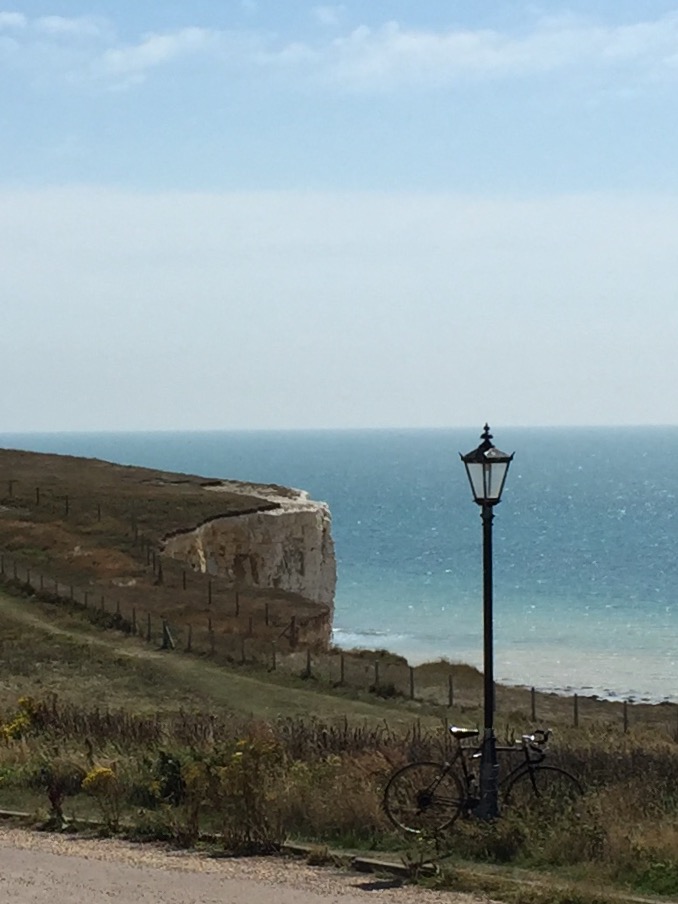
I live with acrophobia, a psychological nuisance more commonly known as a fear of heights, and which loosely translated means being scared of peaks, summits or edges. In other words, when I am in high places I am frequently and irrationally frightened.

I can’t define how ‘high’ high is, sometimes it’s very high, sometimes it’s not so high. I have no fear of flying, for example, or of cleaning the gutters or of looking out of a fifth-floor window. But when it comes to crossing bridges, standing on balconies, dining on rooftop restaurants, walking along cliff-top pathways, or hiking through mountainous terrain, then it’s a different matter.

Peacehaven
Beautiful but daunting

Instead of being pleasant and enjoyable, these activities usually trigger an over-developed sense of survival in which my mind and my imagination become out of kilter. I become aware of myself, of my position in relation to the ground, and of the edge – particularly the edge.

An image of me falling takes on the trappings of a bona fide probability and my body reacts as if I were in genuine danger – which, of course, I am, but no more so than if I were about to cross a road, or if I were standing on a platform awaiting a train.

At these times I realise that the only thing between me and death is an electrical connection in my brain. A decision, a notion, an idea. None of which seem as substantial as ropes and harnesses. I am left wondering: can a thought be stronger than physical movement? If my body receives an impulse is to jump then can my mind stop it? Can I rebel against myself; start a civil war; launch a synaptic coup? I’m frightened that if I imagine it, it might happen.

Sudden and genuine fear is an ugly experience. I’m not used to it and I don’t know how to deal with it. When adrenalin floods my system and freezes my brain, my thoughts become lumpy, less to do with thinking and more to do with thinking about thinking, of simulating thinking, as if each thought is a single, shaky snapshot rather than part of a smooth, continuous film. The first touch of panic, as gentle as a cobweb, soon paralyses and suffocates my reason.

But it’s not the act of being in a high place that’s the problem. If there is no possibility of me falling, then no matter how high I am, I’m fine. The tallest building with glass floors holds no terror for me if it’s sealed, or caged, or otherwise locked down.

The fear arises when there is the possibility of me falling and there is no way of getting down quickly and safely. It’s the fear of panicking. It’s the fear of being trapped and doing something stupid; of doing something impulsive; of behaving like hunted prey which, rather than evading danger, gives itself up to it, embraces it; and gets it over with.

If I’m about to walk across a bridge then the fear increases because I am walking away from safety. If I’m halfway across then the fear subsides because I am walking towards safety. These height-related imaginings are irrational and inconvenient and, excuse the pun, they get me down.

I console myself with the words of GK Chesterton who, to paraphrase, would rather live in the valleys from where everything looks grand and majestic, than live in the mountains from where everything appears small and insignificant.

It would be nice, however, once in a while, to look down rather than up.

Life in the slow lane: a swimmer’s guide to the pool’s natural hazards

I like to go swimming two or three times a week, and I like to swim a length for every year I’ve been alive. Up and down I go, counting the lengths, thinking about how old I’m getting and keeping an eye out for natural hazards. There are a lot of natural hazards in swimming pools.

You see that object face-down in the water? That’s the Drifter. He’s actually doing the breast-stroke but, like driftwood, he needs the ripples and currents caused by other swimmers to move him. It will take him twenty minutes to complete the length.

The large creature that’s just launched itself at the water and landed like a plank is the Bone-Digger. He thinks he’s a shark but he swims like a dog digging up a bone. He is a localised commotion; a splashing and thrashing of arms and legs; a tangle of movement unconnected with swimming. Sometimes I think I can hear him shouting. He manages two lengths and then clings to the side, head down, shuddering, sucking in air.

The pale woman with the chapped legs and the blotchy face is the Weaver. She sets off near-right and arrives far-left, crossing lanes at random, nodding and waving apologetically, peering anxiously through the choppy waters that lie ahead. She knows that soon, inevitably, a preternatural force will draw her into the path of the Swan Ladies.

The Swan Ladies move in a pack, three abreast, an expensive fragrance lingering in their wake. Length after length they glide up and down, heads clear of the water; talking, laughing, drinking tea. They can go on like this for ever, as poised as carousel horses. Despite her efforts, the Weaver bobs helplessly into their path. She disappears and then reappears behind them, bewildered but unharmed. They give no sign of having noticed her.

The tall elderly man standing up to his waist in water at the far end of the pool is the Wader. This veteran hoists his trunks up to his chest and gazes fiercely at his own feet before falling forwards. Below the surface he hovers a few inches above the floor, propelling himself forward with tiny hand movements until half-way along the length he stands up and strides slowly back to the starting point. He’ll do that for the next hour – amassing a vast distance in tiny segments.

The Club Swimmer arrives. She is magnificent. She wears goggles, earplugs, a nose-clip and a rubber swimming-cap. She brings with her fins, bricks and weights. She ties herself up in complicated knots and undulates through the water like a dolphin. We all fear her.

All, that is, except West Coast Boy. He arrives in his brightly patterned board-shorts, slips silently into the water, completes thirty lazy lengths (tumble-turning at each end), and then vaults lightly onto the side, leaving scarcely a ripple. He shakes his floppy hair and ambles off.

There are other hazards – Bubbles Man, The Floater, the Love-Birds and of course, the horrifying Tiny Speedo. I’ve grown accustomed to them. They have been my watery companions for a long, long time; my fellow swimmers, gamely pursuing a means of locomotion for which none of us are designed – and I suppose, as I plow up and down the lengths counting out the years, I should spare a thought for what they might call me.